International Telecommunication Union   ITU
عربي  |  中文  |  Español  |  Français  |  Русский
 
 Advanced Search Advanced Search Site Map Contact us Print Version
 
Home : ITU-T Home
   
ITU Telecommunication Standardization Sector (ITU-T)
Handbook Contact: tsbedh@itu.int

Mitigation measures for telecommunication installations

PART 2: CASE STUDIES


Case study #

2.6

Download PDF ()

Title

Lightning damage to a payphone

Type of trouble

Damage.

Source of trouble

Lightning.

System affected

Customer equipment (Payphone).

Location

Outdoors (in the street or in a campus).

Keywords

Damage, lightning surge, bonding, protection coordination, GDT.

Version date

2004-01-01


System configuration
The problem equipment is a payphone in an outdoor cabinet installed in a university campus. The earth for the mains supply to the payphone cabinet was tens of metres away from the cabinet. The local earth for the cabinet is 10s of ohms. Inside the cabinet is a double-insulated power supply which supplies 21 Va.c. to power the payphone. The payphone has a local earth for coin metering and lightning protection of the payphone electronics and users. Components were being physically damaged in the equipment. It was assumed that lightning was causing this damage. The system configuration is shown in Figure 2.6-1.


Figure 2.6-1 – System configuration


Measurement/Searching techniques/Experiment

The damaged components were identified by normal service technique. The dies of these components were then examined using both optical and electron microscopes. As recommended in Rec. ITU-T K.21, different types of lightning surges were applied to the payphone external conductors – i.e., the telephone line and the mains cable – in an attempt to replicate the damage. No damage could be caused at K.21-enhanced test levels.

It was then decided to inject surges into the low-voltage cable between the transformer and the electronics. This would not normally be done because the length of the cable between the transformer and the electronics is short and the cable is contained within a metal cabinet.

It was found that current limited 1.2/50 µs surges applied longitudinally to this low-voltage cable could reproduce the component damage as observed by a microscope.

The damage path was via the power supply port, damaged components and the internal telephone line protection circuit to the payphone earth. To prevent damage, bypass protection was added from the power supply input to the common earth point within the unit.


Mitigation method/Results/Conclusion

It is assumed that a lightning surge on the mains exceeds the breakdown voltage of the power supply transformer (8 kVd.c.) and injects current limited surges into the payphone 21 Va.c. power supply. This type of damage was not detected during testing of the mains input at 6 kV 10/700 µs (enhanced inherent mains port test).

The implemented solution is shown in Figure 2.6-2. A gas discharge tube (GDT) has been added to the low-voltage power connection to the electronics. This GDT is bonded to the frame earth, the same earth as the exchange line surge protective device (SPD), to reduce the level of stress which can occur between the low-voltage port and the telecommunication line port.
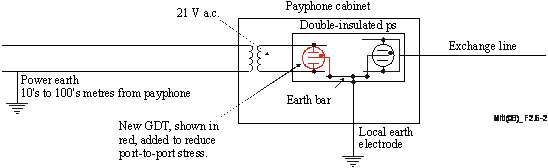


Figure 2.6-2 – Implemented solution
 

It is necessary to be careful when using a GDT on an a.c. circuit as it may not switch off after being triggered by a lightning surge. If the GDT continued to conduct a.c. current, the power supply and the payphone electronics could be damaged, due to overheating of the GDT. There are a number of ways to overcome the problem of the GDT conducting a.c. current:

  • Use a special GDT for a.c. circuits.
  • Use a positive temperature coefficient thermistor (PTC) or similar between the GDT and the transformer.
  • Use an alternative mitigation technique.

An alternative solution is shown in Figure 2.6-3 below. The GDT does not conduct a.c. current in this case, due to the low voltage (21 V) involved.
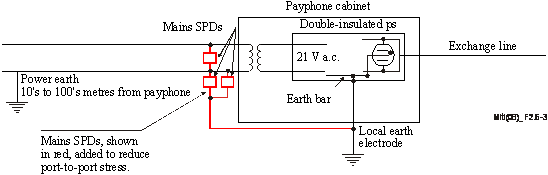


Figure 2.6-3 – Alternative solution


References

Recs ITU-T K.21 and ITU-T K.44.


Table of content


Top - Feedback - Contact Us -  Copyright © ITU 2010 All Rights Reserved
Contact for this page : TSB EDH
Updated : 2010-06-29